Мы достигли пика неэффективности
Очередная попытка рассказать о проблеме, которая у нас из разряда «мы все понимаем, как это плохо и тянет на дно, но давайте сделаем вид, как будто это ок и ничего менять не надо». Проблема, что теперь наша работа - это встречи.
Выделил для нас самые сильные цитаты:
In 2016, group of work researchers calculated that time spent in meetings had increased by 50 percent since the 1990s. «Collaboration is taking over the workplace» they wrote in an article in Harvard Business Review.
«I think we’ve hit the high point of max human inefficiency in white-collar work» Jared Spataro, a vice president at Microsoft who focuses on artificial intelligence and work trends, told me. «It sometimes seems as if the modern worker spends more time talking about work than actually working.»
«In the last few years, the business world has focused much more on inclusion and on letting more people’s voices be heard in decision-making» he said. Inclusion can be a virtue, Spataro emphasized. But it can also be a cost. A business culture that allows more people to «say their piece» is, automatically, one that requires people to spend more time listening to other people talk. In some decisions, that might be appropriate. At extremes, an office that requests more input is an office where talking about work can intrude on efficient decision making.
Perhaps the most common critique is that many meetings are theatrical presentations of information best conveyed in an email.
The typical meeting is a leaky time suck, absorbing people’s attention in a way that cannot be fully measured by simply counting up the total number of hours blocked out for calls.
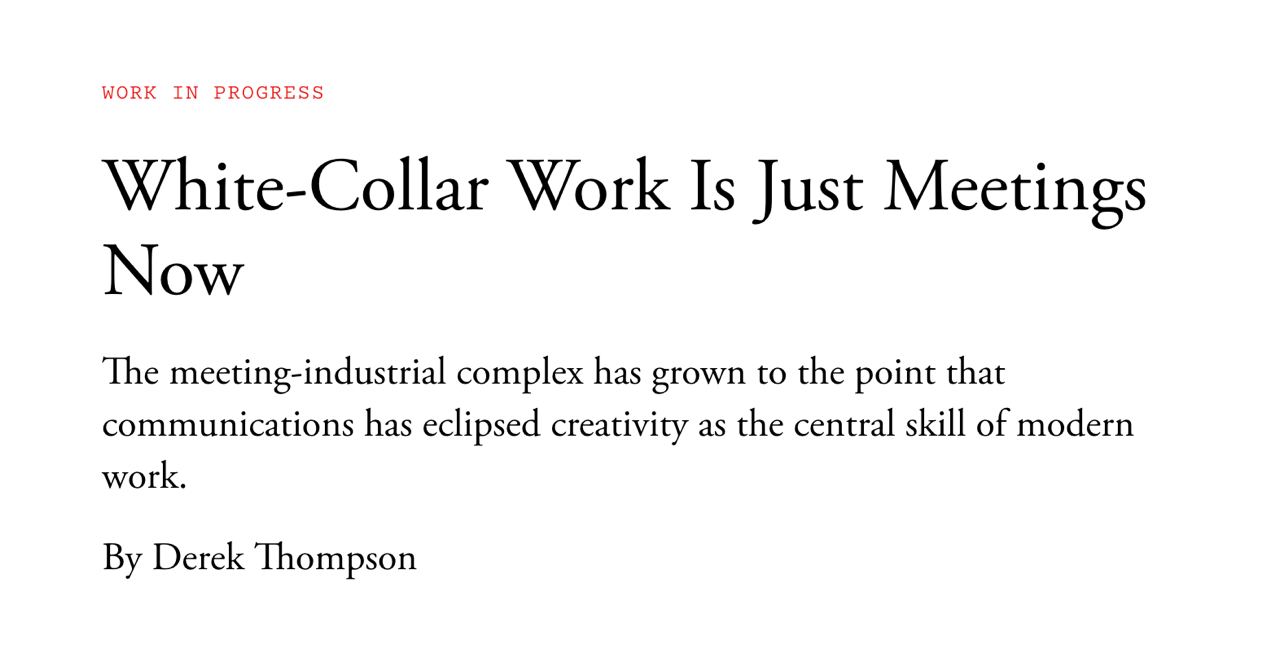
Altogether, the meeting-industrial complex has grown to the point that communications has eclipsed creativity as the central skill of modern work.
As we’ve built more communication tools knowledge work has become more and more about talking. Rather than making workplace communication more efficient, office technology has mostly made it more inescapable.