AI in Information Security: Weapon, Shield, and a New Front
AI is no longer a buzzword bolted onto a SIEM — it's a battlefield where both sides fight with the same tool, expanding attack surfaces, sharpening attackers, and reshaping defense.
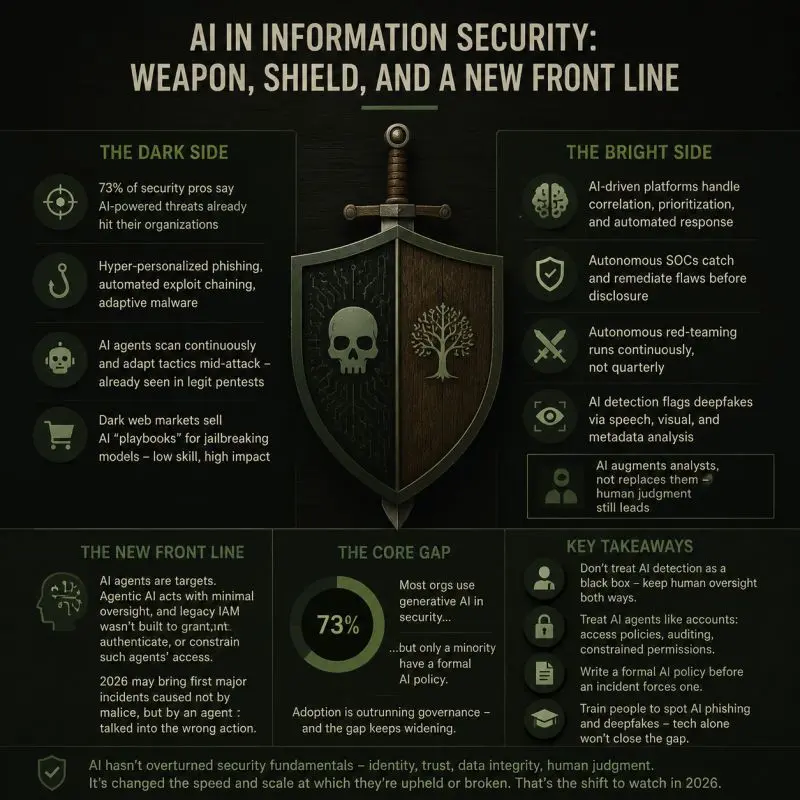
Dark side: 73% of security pros say AI-powered threats already hit their organizations — hyper-personalized phishing, automated exploit chaining, adaptive malware. AI agents now scan targets continuously and adjust tactics mid-attack, a capability already seen in legitimate pentests. Dark web markets even sell ready-made "playbooks" for jailbreaking AI models, letting low-skill actors run attacks they couldn't manage alone.
Bright side: the same capabilities work in reverse. AI-driven platforms increasingly handle event correlation, threat prioritization, and automated first-response — things legacy tools can't match at modern attack speed. Autonomous SOCs catch and remediate flaws before disclosure; autonomous red-teaming runs continuously, not quarterly; AI detection flags deepfakes via speech, visual, and metadata analysis. But AI augments analysts, not replaces them — gray-area judgment calls still need a human.
New front line: AI agents are becoming targets themselves. Agentic AI acts with minimal oversight, and legacy IAM wasn't built to grant, authenticate, or constrain such agents' access. Experts warn 2026 could see the first large-scale incidents caused not by malice but by an agent simply talked into the wrong action — these systems are built to be helpful, not to weigh consequences.
Core gap: most orgs already run generative AI in their security stack, but only a minority have a formal AI policy. Adoption is outrunning governance, and that gap isn't shrinking year over year — it keeps widening.
Takeaways: Don't treat AI detection as a black box — keep human oversight both ways. Treat AI agents like accounts: access policies, auditing, constrained permissions. Write a formal AI policy before an incident forces one. Train people to spot AI phishing and deepfakes — tech alone won't close the gap.
AI hasn't overturned security fundamentals — identity, trust, data integrity, human judgment. It's changed the speed and scale at which they're upheld or broken. That's the shift to watch in 2026.